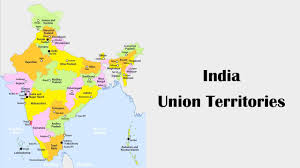
What is Union Territories?
- As per the Constitution provisions, during independence, the union territories were either not a part of India or they were too small to be made into a state.
- Further, the States Reorganisation Commission in 1956 recommended generating a different category for these territories named Union Territory
History of Union Territories
- The concept of a ‘Union Territory’ is unique to India.
- First introduced in the States Reorganisation Act of 1956, the term refers to those territories that were too small to be independent or too significantly different (economically, culturally or geographically) to be merged with the states that surrounded them. These territories were to be administered directly by the Centre.
- The State Reorganisation Commission (SRC) was inspired by the “major and minor provinces” that existed at the “close of the 18th century”. These were managed by governors and chief commissioners and the central government respectively.
- Initially, the Constitution recognised four different categories of territories in Schedule 1: Former British India provinces (Part A), princely states (Part B), chief commissioner provinces (Part C) and the Andaman and Nicobar Islands (part D).
- When the states were reorganised, Part D became the basis for UTs. During the discussion on reorganisation of states in 1956, the States Reorganisation Commission recommended creation of a different category for these territories since they neither fit in the model of a state nor do they follow a uniform pattern when it comes to governance
UTs: Constitutional Status
- The Union Territories are specified in Schedule I Part II of the Constitution of India.
- These territories are administered in accordance with the provisions of Article 239 to 241 of the Constitution of India.
- Under the Government of India (Allocation of Business) Rules 1961, Ministry of Home Affairs is the nodal Ministry for all matters of Union territories relating to Legislation, Finance & Budget, Services and appointment of Lt. Governors and Administrators.
- Every Union territory is administered by an Administrator appointed by the President under Article 239 of the Constitution of India.
- In Andaman & Nicobar Islands, Puducherry and Delhi, administrator is called Lt. Governor, while in Chandigarh, Dadra & Nagar Haveli, Daman & Diu and Lakshadweep he/ she is known as Administrator.
9 union territories in India:
- Andaman and Nicobar Islands, Chandigarh, Dadra and Nagar Haveli and Daman and Diu, National Capital Territory of Delhi, Jammu and Kashmir, Lakshadweep, Ladakh and Puducherry.
Union territories with their own elected legislatures and governments:
| Name | UT established |
| Delhi | 1 November 1956 |
| Jammu and Kashmir | 31October 2019 |
| Pondicherry | 1 November 1954 |
Union territories without elected legislatures:
| Andaman and Nicobar Islands | 1November 1956 |
| Chandigarh | 1 November 1966 |
| Dadra and Nagar Haveli and Daman and Diu | 26 January 2020 |
| Lakshadweep | 1 November 1956 |
| Ladakh | 31 October 2019 |
Former Union territories:
| Name | UT established | UT disbanded | Today part of |
| Arunachal Pradesh | 21 January 1972 | 20 February 1987 | As an Indian State |
| Dadra and Nagar Haveli | 11 August 1961 | 26 January 2020 | Dadra and Nagar Haveli and Daman and Diu union territory |
| Daman and Diu | 30 May 1987 | 26 January 2020 | Dadra and Nagar Haveli and Daman and Diu union Territory |
| Goa, Daman and Diu | 19 December 1961 | 30 May 1987 | Goa state and Dadra and Nagar Haveli and Daman and Diu union Territory |
| Himachal Pradesh | 1 November 1956 | 25 January 1971 | As an Indian State |
| Manipur | 1 November 1956 | 21 January 1972 | As an Indian state |
| Mizoram | 21 January 1972 | 20 February 1987 | As an Indian state |
| Nagaland | 29 November 1957 | 1 December 1963 | As an Indian state |
| Tripura | 1 November 1956 | 21 January 1972 | As an Indian state |
Power of Union Territories
- UTs are administrated by the President acting to such extent.
- Administrators of Andaman and Nicobar Islands, Delhi and Puducherry are designated as Lieutenant Governors.
- The Governor of Punjab is concurrently the Administrator of Chandigarh. The Administrator of Dadra and Nagar Haveli is concurrently the Administrator of Daman and Diu. Lakshadweep has a separate Administrator.
- The NCT of Delhi and UT of Puducherry each has a legislative assembly and council of ministers. Legislative assembly of UT of Puducherry may make laws with respect to matters enumerated in List II or List III in the Seventh Schedule of the Constitution in so far as these matters are applicable in relation to the UT.
- The legislative assembly of NCT of Delhi has also these powers with the exceptions that Entries 1, 2 and 18 of the List II are not within the legislative competence of the legislative assembly. Certain categories of Bills, however, require the prior approval of the Central government for introduction in the legislative assembly.
- Some Bills, passed by the legislative assembly of the UT of Puducherry and NCT of Delhi are required to be reserved for consideration and assent of the President.
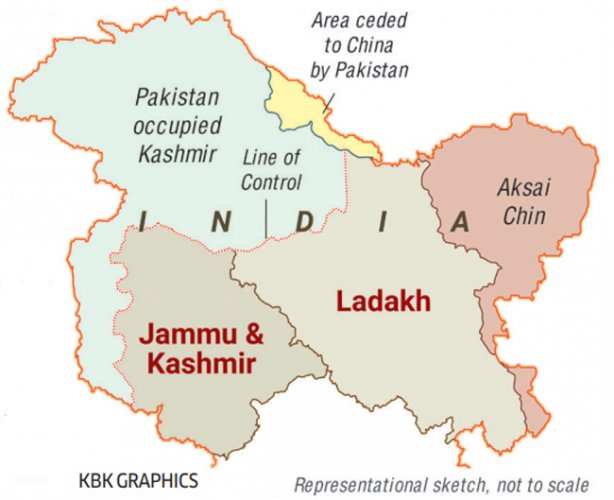
Extent of Legislative Power for Jammu and Kashmir
- The Jammu and Kashmir Reorganisation Bill, 2019 paves the way for formation of the UT of J&K.
- It will join two other UTs — NCT of Delhi and Puducherry — which, through Article 239 A of the Constitution, have a legislative assembly to enact laws on certain subjects and a Council of Ministers headed by a Chief Minister to aid and advise the Lieutenant Governor on subjects related to such legislation.
- For subjects outside the purview of the assembly, the Lieutenant Governor does not need the aid and advice of the Chief Minister.
- Section 13 of the Bill states that the provisions contained in Article 239 A of the Constitution that are applicable to UT of Puducherry shall also apply to the UT of J&K. The UT Assembly has the power to enact laws on matters under the State List and the Concurrent List, barring subjects that are exclusively under the ambit of the Union government.
- In the J&K Bill, Section 32 proposes that the assembly can make laws on any subjects in the State and Concurrent lists except on state subjects relating to “public order” and “police”. Therefore, all laws on these two subjects will be directly under the Centre. This is the case in Delhi, too.
- In Delhi, by insertion of Article 239AA and by virtue of the Sixty-ninth Constitutional Amendment passed by Parliament, the Assembly cannot legislate on matters in entry 18 of the State List, which is land. In J&K, the Assembly can do so.
- Further, Section 53(2)(iii) of the Bill states that the Lieutenant Governor shall, in the exercise of his functions, act in his discretion, in matters related to “All India Services and Anti-Corruption Bureau”. Therefore, all appointments and other administrative matters related to the ACB will be directly under the Lieutenant Governor.
- In addition to it, Part XIII and Section 88(4) of the Bill makes it clear that the Lieutenant Governor will have discretionary powers relating to composition, strength and allocation of officers of the Indian Administrative Service, Indian Police Service and Indian Forest Service.
 Future Officers